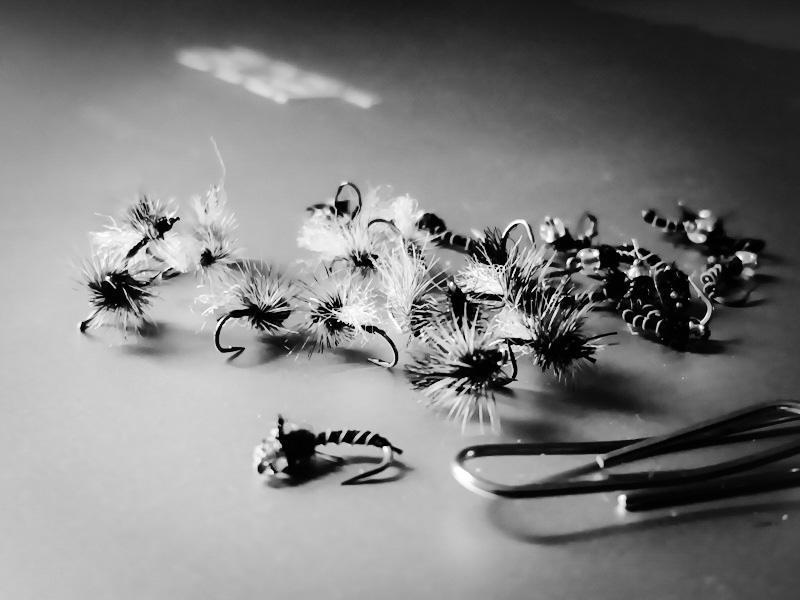
Midges. Some dries and nymphs. Fairly small: size 20,18. Sometimes I tie smaller. On one of my favorite tailwater rivers in central Montana I’ll fish a midge dry down and across to a rising or bulging (midging) trout on a flat water section. If no response after a few drifts then I try a few other other patterns including some suspender types, etc. If still no success then I’ll tie on a lightly weighted Zebra nymph (plastic clear bead on head and a few wraps of wire on body to help it break the surface) just 3 or 4 inches below the dry. Then I go with the same presentation angle (down and across). If still unsuccessful then I try slightly twitching the dry and nymph (upstream movement) just in front of the feeding fish. Often this will elicit a response, sometimes on the dry but usually on the nymph which is hanging slightly below the surface and with the movement/ twitch may look like it is emerging/ rising in the water. Sometimes the movement catches a trout’s eye and it lunges for the impression (dry or nymph). Some of my best Springtime angling has been midge fishing in the morning in a protected area where the wind is light or non-existent and some fish are “up” on them. On those days I’m usually just hanging-out hoping for a good Blue Winged Olive hatch to begin in the afternoon. A few solid trout on Springtime midges is a great way to kick-off the season…

 trout on dries